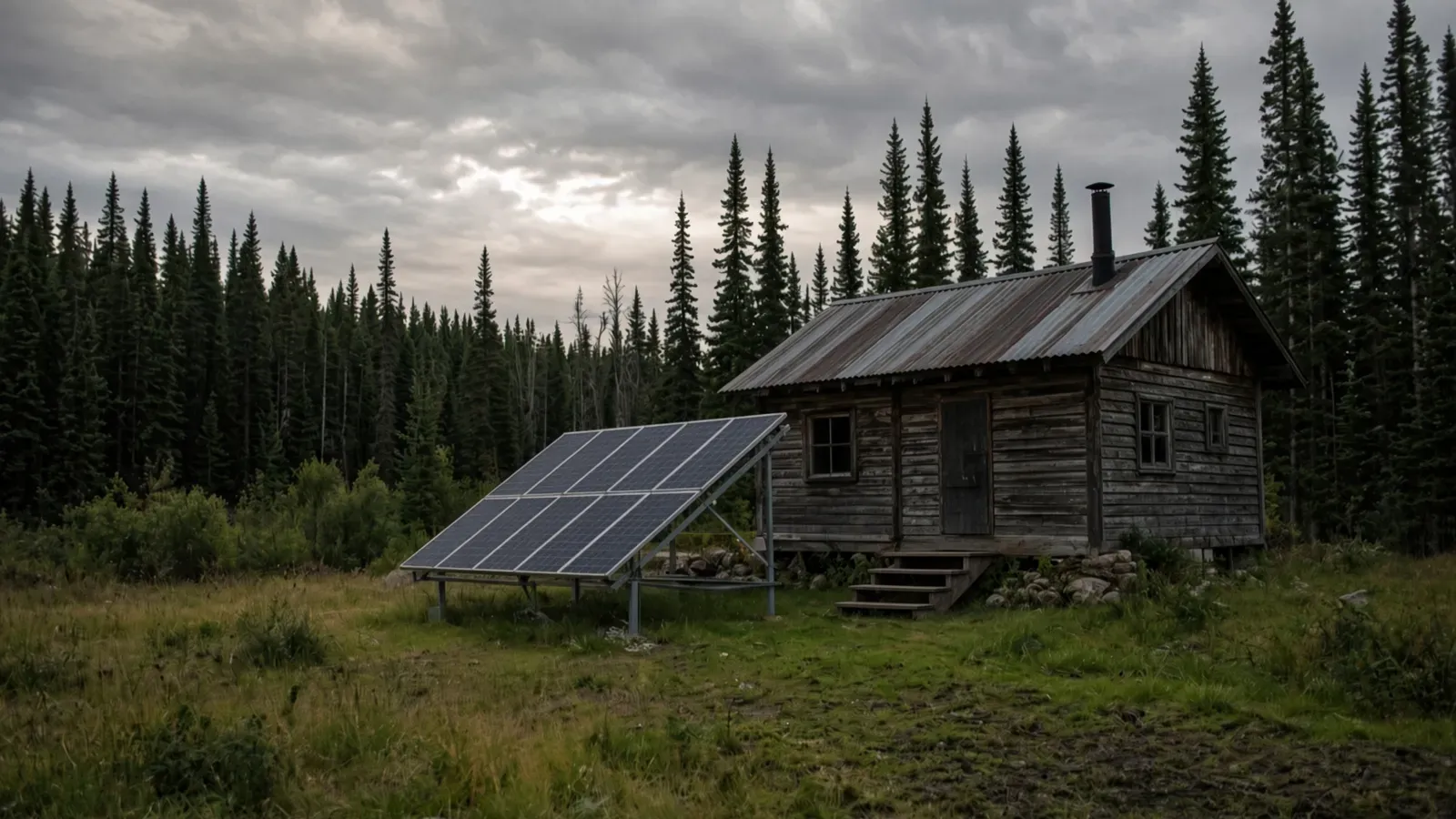
Off-Grid Solar for Cabins, Homesteads, and Tiny Houses
Off-grid solar means generating and storing all of your own electricity, with no connection to the utility grid. No monthly bill and no power company. Also no safety net when something has been sized wrong.
What an off-grid system actually is
Every off-grid system, from a shed light to a full homestead, is the same four parts doing the same four jobs.
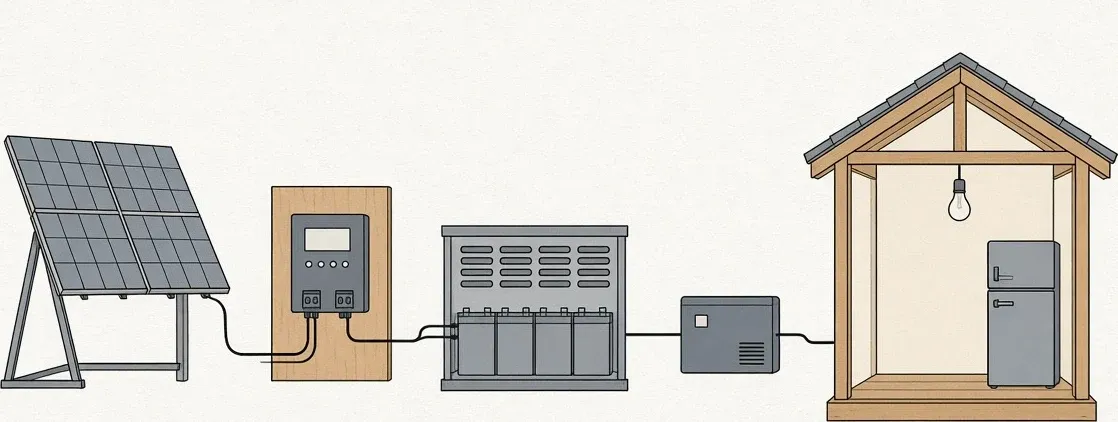
- Solar panels generate direct current whenever light hits them. They are the cheapest part and last for decades.
- A charge controller sits between the panels and the batteries, converting whatever the panels are producing into the correct charging voltage. Without one, panels destroy batteries.
- Batteries store the energy so you have power at night and through bad weather. This is the most expensive part, the shortest-lived, and the least forgiving of design mistakes.
- An inverter converts stored direct current into the alternating current that household appliances expect.
Everything else is wiring, protection, and mounting. The engineering is not mysterious. What makes off-grid difficult is that all four parts have to be sized against each other and against how you actually live.
Why this is not the solar you see on suburban roofs
Grid-tied solar treats the utility as an infinite battery. It sends surplus out during the day and pulls power back at night, so a system that falls short simply buys the difference. Nobody notices.
Off-grid has no such fallback. If your array and battery bank cannot carry you through a cold, overcast week in December, the lights go out. That single difference drives everything: it is why off-grid systems are sized against the worst month rather than the annual average, why battery choice matters so much, and why the honest cost is higher than the panel price suggests.
It also means the expensive mistakes happen at the design stage, long before anything is bolted to a roof.
What this site is
A reference guide. The aim is to explain how the parts work, what the numbers on a specification sheet actually mean, and where money gets wasted, so you can specify a system yourself or ask an installer better questions.
You will find three kinds of thing here:
- Reference articles explaining each component, the trade-offs between them, and the safety practice that goes with them.
- Calculators for the arithmetic that decides a system: wire sizing, battery runtime, daily power budget, and array sizing.
- Buying guidance comparing the equipment that is actually worth considering, and explaining why.
Wiring guidance here follows the NEC (NFPA 70), the electrical code used in the United States. If you are wiring a boat or an RV, ABYC standards apply instead and will give you different, generally more conservative answers.
Who it is for
Mostly people building small to mid-sized systems for cabins, homesteads, and tiny houses, where there is no utility service and the system has to stand on its own.
It also covers backup power for homes that do have grid service, for riding out outages. That is a genuinely different problem with different equipment and different rules, so it is kept separate rather than blended in. Connecting a battery system to house wiring that can reach the utility is the one area where a mistake can injure someone outside your home.
Start here
If you are new to this, read them in this order.
- Off-Grid Solar Basics
How an off-grid solar system works end to end, the vocabulary you need to read the rest of the guide, and the order in which the decisions have to be made.
- Solar Panels Explained
How to read a solar panel datasheet, what monocrystalline and polycrystalline actually change, why panels never make their rated power, and how wiring them in series or parallel affects the rest of the system.
- Solar Panel Safety
Working safely with solar panels: why an array is live whenever there is light, DC arc hazards, roof and ground-mount risks, and safe wiring practice.
- Solar Charge Controllers Explained
What a charge controller does, how MPPT and PWM differ, how to size one correctly, and why panel voltage decides which type is worth buying.
- Off-Grid Battery Basics
How off-grid batteries actually work: chemistry differences, usable versus rated capacity, cycle life, and how to compare real cost per kilowatt-hour.
- How to Size an Off-Grid Battery Bank
A step-by-step method for sizing an off-grid battery bank, including days of autonomy, depth of discharge, inverter losses, and the cold-weather derate people forget.
- Lithium vs AGM: Where Each One Still Wins
A direct comparison of lithium, AGM and flooded lead-acid for off-grid use, on usable capacity, cycle life, real cost per kilowatt-hour and cold weather behavior, including the two cases where lead-acid is still the right answer.
- Off-Grid Battery Safety
The real hazards of an off-grid battery bank: short-circuit energy, hydrogen venting, thermal runaway, and the overcurrent protection that prevents all three.
- Off-Grid Inverter Basics
What an off-grid inverter does, why pure sine wave matters, how to size continuous and surge capacity, and how off-grid, hybrid, and grid-tie inverters differ.
- Off-Grid Wiring and Safety
Conductor sizing, voltage drop, overcurrent protection, grounding, and disconnects for off-grid DC systems, following the NEC.
- DC Voltage Ratings: Why a 48V Switch Is Not for a 48V Bank
A 48 volt battery bank is never at 48 volts. Published maximum voltage ratings for common battery switches and fuses, why a part labeled 48V is the wrong part, and how to check a rating against the number that matters.
- Fuse Interrupt Rating: 12V Is Not 48V
Interrupt capacity is the fuse specification most off-grid builds get wrong. Published AIC figures for Class T, ANL, AMG and MRBF terminal fuses, and why one of them changes verdict entirely between 12 and 48 volts.
- Generators for Off-Grid Systems
Choosing and sizing a generator for an off-grid system: why it charges the bank rather than running the house, why an inverter/charger can refuse dirty power, and why propane usually beats gasoline off-grid.
- Solar Well Pumps: What Actually Sets the Size
Sizing a solar well pump by total dynamic head rather than by well depth, why a pressure tank is usually most of the work, and why the spec that decides whether a generator can start an AC pump is not published.
- Off-Grid Solar in Cold and Difficult Climates
How cold, snow, short winter days, and extreme heat affect an off-grid system, and how to size and site one so it works in the month that matters.